
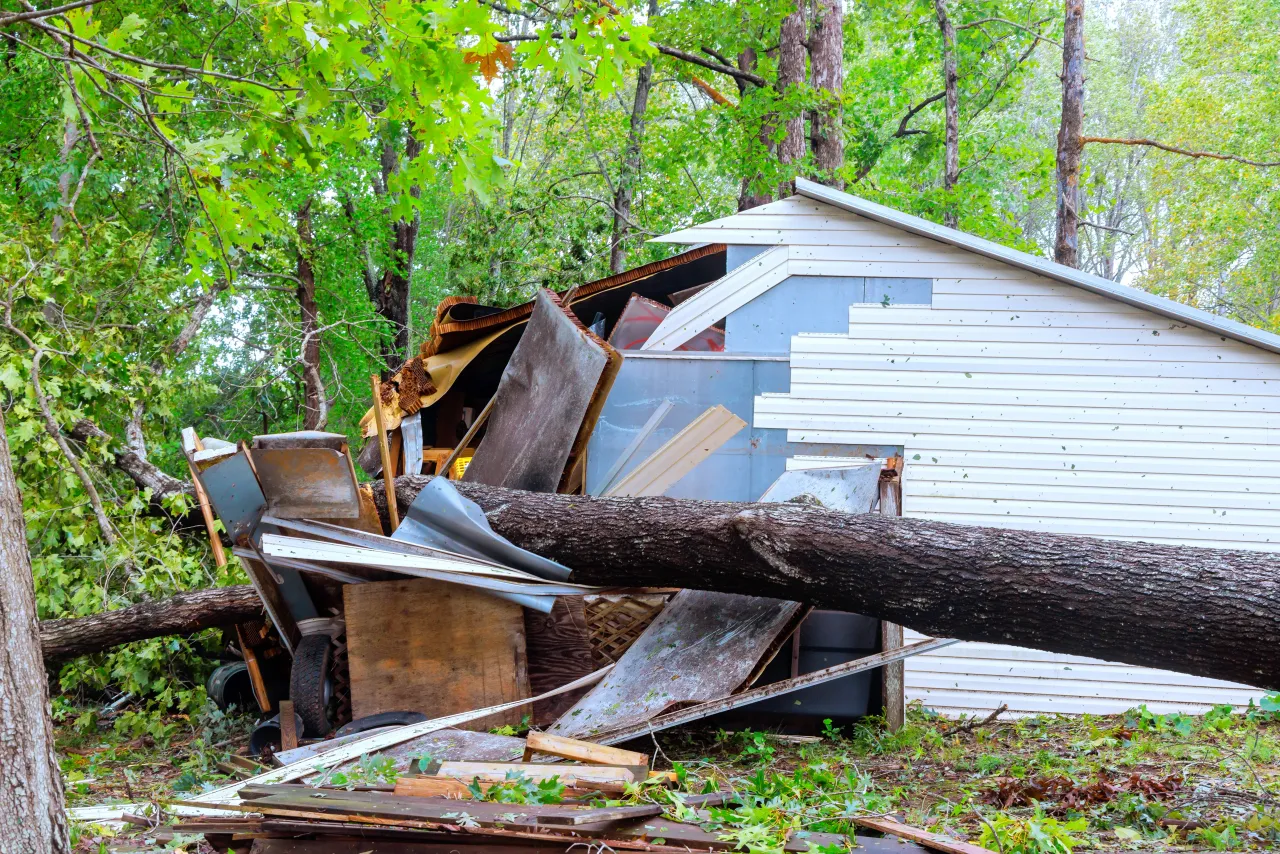
Michigan storms arrive as a line and leave in twenty minutes. What they leave behind is remarkably consistent: limbs on roofs, siding peeled off the windward wall, shingles in the neighbor's yard, and water finding every opening the wind just made. The hour after the sky clears is when most avoidable damage happens, because that is when people climb things and move things.
Work the list in order.
1. Safety first, and safety means electricity
Assume every downed line is live and stay well clear, including anything a line is touching — a fence, a puddle, a limb. Call the utility and 911 for lines in the road. Inside, if water has reached outlets, panels or the furnace, kill power at the main before you walk through it. If you smell gas, leave and call from outside.
Look up before you go anywhere. Partially separated limbs and lifted roof decking drop later, without warning. And generators live outside, never in a garage — every storm season brings carbon monoxide calls that had nothing to do with the storm.
2. Get the building closed in
Every hour a hole stays open, the loss grows. Emergency board-up and tarping is the single highest-value thing a contractor does on day one, and it is nearly always a covered mitigation expense. That means shrink-wrap or tarp over exposed decking, plywood over broken glass and doors, and a temporary patch on punctures.
What it does not mean is you on a wet roof with a tarp and a staple gun. Nothing in your policy requires that, and falls are the most common storm injury we hear about.
- Move furniture and rugs out of wet rooms; lift what you can onto blocks.
- Catch active drips in buckets and pull soaked contents off the floor.
- Clear ground-level debris away from doors, walkways and downspouts.
- Photograph everything as you go, before it moves.
3. Treat standing water as a clock, not a puddle
Storm water is not clean water. Once it has crossed a yard, a roof or a street, it carries soil, bacteria and whatever was in the gutter. That changes both handling and disposal: contaminated water means porous materials it touched generally come out rather than get dried, and it means gloves, boots and no bare-hand contents sorting.
Extraction should start the same day. So should dehumidification — in a Michigan August, the air in a flooded basement is doing as much damage as the water was.
Wind damage is a one-time event. Water damage is a process. Only one of them gets worse while you decide what to do.
4. Document before the cleanup erases it
Storm claims turn on cause. An adjuster arriving four days later needs to see that the water came in through wind-created openings, not that a roof was simply old. Give them that record.
- Wide exterior shots of all four elevations plus the roofline from the ground.
- Close-ups of each opening, with something for scale.
- Interior shots showing the water path from the opening down.
- The date and time of the storm, and receipts for anything you buy or discard.
Then open the claim and note that emergency mitigation is in progress. Carriers expect that.
One crew, mitigation through rebuild
A storm loss usually needs three trades: someone to close the building, someone to dry it, and someone to put the roof, siding and interior back. We are all three, which is the whole point — no gap between the tarp and the shingles, and no second estimate to wait on. On site in two to four hours, 24/7, across Genesee County and Metro Detroit.
Emergency board-up and tarping, day or night. Then we rebuild it.