
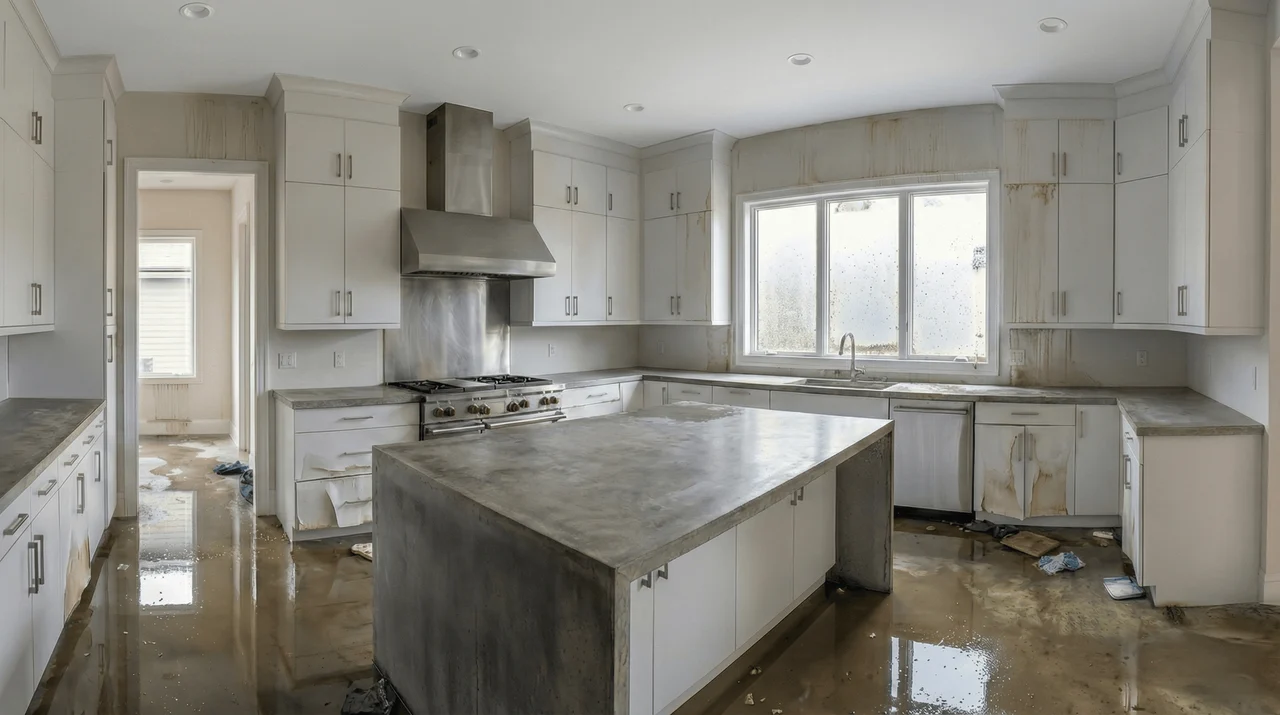
Most Fenton basement flooding we respond to is groundwater, not a pipe. Frozen or saturated soil cannot absorb rain and snowmelt, so water travels to the lowest available path — the backfill against your foundation — and finds the cove joint, a crack, or a sump that cannot keep up.
Where the risk actually comes from
- High water table and lake proximity. A spring rise puts hydrostatic pressure against the slab and the base of the wall.
- Clay soils. Clay drains slowly and holds water against the foundation instead of letting it move away.
- Grading that has settled toward the house. You want roughly six inches of fall in the first ten feet; most flooded homes have less on at least one elevation.
- Downspouts discharging at the wall. The most concentrated water source your basement will ever face, and the cheapest to fix.
- Sump systems at end of life. Seven to ten years is typical, and spring is when an aged or unbacked-up pump gets found out.
- Older foundations. Block walls, mortar joints and the cove joint all seep under pressure, often after months of staying dry.
The pattern and the fixes are laid out in more detail in why basements flood in spring around Grand Blanc and Genesee County.
First steps when your basement floods
Safety
If water is near outlets, the panel, the furnace or a submerged appliance, shut those circuits off at the breaker from a dry position.
Identify the water
Clean supply water, grey water, or sewage. That call decides what can be saved and what has to come out.
Get contents up
Off the floor and away from wet walls. Cardboard and upholstery wick fastest.
Photograph first
Every room, wide then close, plus the water line on the wall — before anything moves.
Extract
Same-day removal of standing water, then drying. Waiting is what turns this into a mold job.
Why professional water cleanup is critical
A wet-vac and a box fan address the water you can see. The damage lives in what you cannot: pad, subfloor, the bottom of the drywall, and insulation held against the framing. Professional cleanup adds four things a rental cannot.
- Measurement. Meter readings and thermal imaging define the real extent, so nothing wet gets closed up.
- Extraction depth. Equipment that pulls water out of pad and cavities, not just off the surface.
- Dehumidification. Removing moisture from the air rather than moving humid air around the room.
- A verified endpoint. Equipment leaves when materials read dry, and you get the readings in writing.
A finished basement hides water beautifully. That is the entire problem.
What it costs to wait
Mold can begin on wet cellulose within 24 to 48 hours, and standing water degrades from clean toward contaminated as it sits in a warm space. Same-day extraction is routinely the difference between drying a wall and removing it.
Reducing the risk before next spring
- Extend downspouts six to ten feet from the foundation, discharging downhill.
- Rebuild the grade in the first ten feet with compacted clay, sloping away.
- Test the sump twice a year, add a battery backup and a high-water alarm.
- Cover and drain window wells.
- Have active cracks injected properly rather than smeared with hydraulic cement.
- Consider interior drain tile where seepage along the cove joint is chronic.
Local response
We are in Grand Blanc, minutes from Fenton, with 24/7 dispatch answered by our own team and crews typically on site in two to four hours. See the Fenton service page or call (810) 355-4775.
Frequently asked questions
Why does my Fenton basement flood when my neighbor’s does not?
Usually grading, downspout discharge, sump capacity or the condition of the foundation joints — small differences that decide where water goes first.
Does insurance cover basement flooding?
Groundwater and surface water are typically excluded; sump or sewer backup requires an endorsement; sudden plumbing failures are usually covered. Check your declarations page.
Do I have to remove the drywall after a basement flood?
Not always. Readings decide. Saturated pad and base trim usually go, and what can be dried in place gets dried in place.
How much does water damage cleanup cost?
It depends on the water category, the square footage and how long it sat. The single biggest cost variable is response time, which is why same-day extraction pays for itself.
Can Apex come out tonight?
Yes. We run 24/7 dispatch and are typically on site in two to four hours across Genesee County.
Certified crews, documented drying, and the rebuild handled by the same team.