
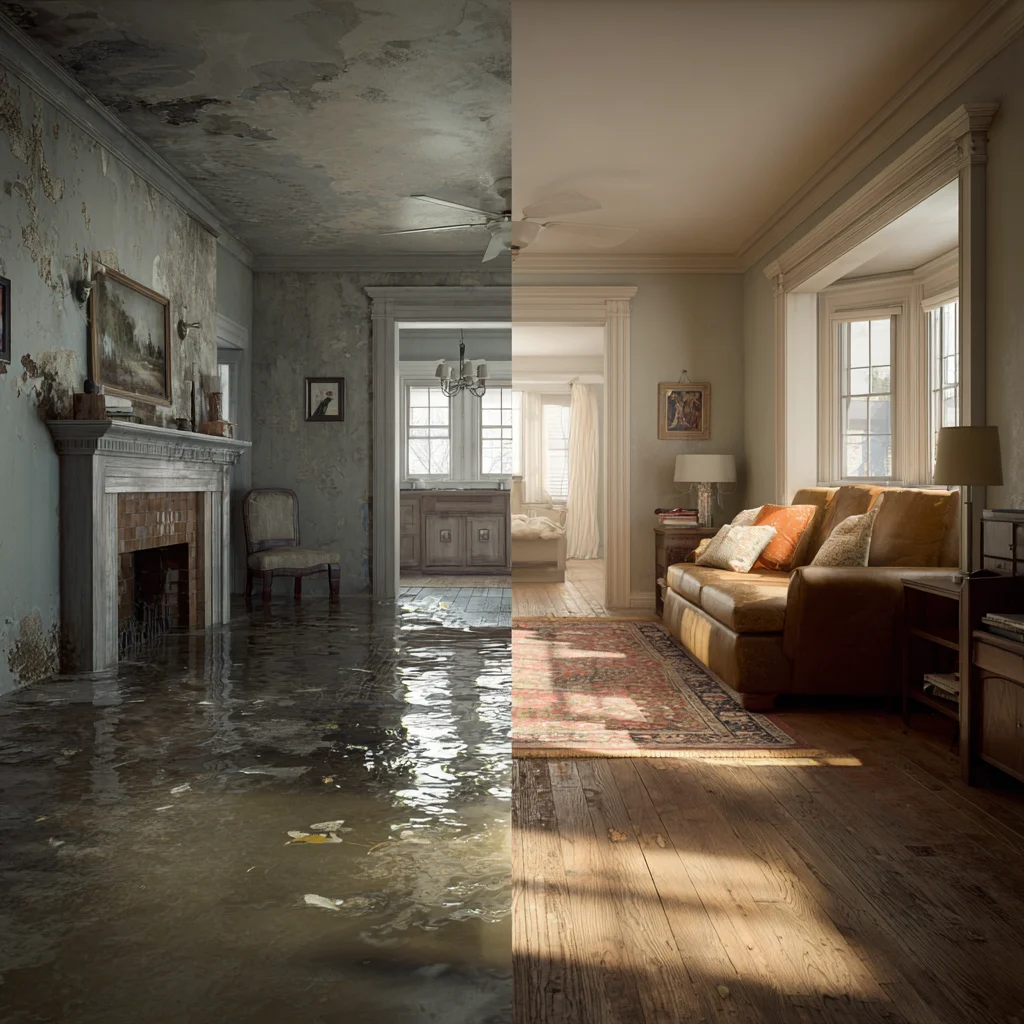
You do not need to know restoration to handle the first hour well. You need to be safe, be quick, and write things down. Here is the order we would want a family member to follow.
Prioritize safety above all
- Do not enter standing water if it is near outlets, the electrical panel, the furnace or a submerged appliance. Shut those circuits off at the breaker first, from a dry position.
- Treat floodwater from outside, or anything involving a sewer or septic line, as contaminated. Boots, gloves, and children and pets out of the area.
- Watch the ceiling below a flooded level. Sagging drywall holding water is a collapse risk — stay out from under it.
- If you smell gas, or the water reached the furnace or water heater, leave and call the utility.
Act fast — time is critical
Water spreads horizontally in minutes and wicks vertically for hours. Drywall pulls moisture eight to sixteen inches above the waterline, insulation holds it against the framing, and carpet pad soaks from beneath. Mold can begin growing in wet cellulose materials within 24 to 48 hours, and clean water sitting in a warm house degrades toward contaminated as bacteria multiply.
Stop the source
Main water shut-off, the nearest branch valve, or confirm the sump discharge is flowing away from the house.
Get things up
Contents off the floor, furniture off wet carpet, rugs out, anything cardboard moved — boxes wick water upward fast.
Move standing water
Shop vac or transfer pump to a floor drain or laundry sink. Do not use a household vacuum on contaminated water.
Call for extraction
Professional extraction removes what a wet-vac cannot reach: pad, cavities, under cabinets, seams.
Document before you clean
- Wide photos of every affected room before anything moves, then close shots of the damage and the source.
- Photograph the water line on the walls, and note the time you discovered it.
- List contents as you set them aside: item, approximate age, approximate value.
- Keep receipts from hour one — equipment rental, accommodation, everything.
- Do not discard damaged items until they are recorded. Undocumented loss is unreimbursed loss.
This is the file your adjuster works from. We build it as a matter of course — see what good damage documentation looks like.
What not to do
- Do not open the windows on a humid day. You are adding moisture, not removing it.
- Do not rely on household fans. Air movement without dehumidification just redistributes wet air, and over contaminated water it aerosolizes it.
- Do not wait for the adjuster to start mitigation. Policies generally expect you to prevent further damage.
- Do not assume dry. Carpet that feels dry on top with a saturated pad underneath is the most common repeat call we take.
- Do not put it back early. New baseboard and paint over a wet cavity buys three weeks and doubles the scope.
You cannot judge a water loss by how the floor feels. Materials either read dry or they do not.
What professional restoration adds
- Category determination, which decides what can be dried in place and what has to come out.
- Moisture mapping and thermal imaging, so the scope covers where the water actually went.
- Extraction and structural drying monitored daily against a dry standard.
- Containment and HEPA filtration while materials are disturbed.
- Reconstruction by the same team — drywall, flooring, trim and paint back to pre-loss condition.
We answer 24/7
Apex is based in Grand Blanc and serves Linden, Fenton, Flint and the surrounding communities, with most calls on site in two to four hours. If your basement is filling right now, stop reading and call (810) 355-4775. If it is already dry to the touch, it is still worth a set of readings — here is why.
Frequently asked questions
What should I do first when my house floods?
Make it safe — shut off power to wet areas from a dry position — then stop the source, lift contents off the floor, photograph everything, and call for extraction.
How long do I have before mold starts after a flood?
Mold can begin on wet cellulose materials within 24 to 48 hours. Extraction and drying inside that window is what keeps a flood from becoming a remediation project.
Can I dry out a flooded basement myself?
You can remove standing water and slow the damage. What you cannot do is dry wall cavities, subfloor and pad, or verify a dry standard — which is where repeat mold problems come from.
Is flood damage covered by homeowners insurance?
Sudden internal plumbing failures usually are. Rising surface water and groundwater usually are not — that is flood insurance. Sump and sewer backup needs its own endorsement.
How fast can Apex get to me?
Most calls across Genesee County are on site within two to four hours, any hour, dispatched by our own team.
Stop reading and call. Our on-call team answers 24/7.